Reuse developments: preparation for reuse
Extending the useful life of electronic devices and components is one way to further reduce the environmental impact of using such equipment, as fewer new devices need to be manufactured. Devices can be returned to consumers from the world of waste, or simply used for longer within the world of products. Regardless of the method, public demand for products to have longer useful lives is on the rise. Policymakers are laying the foundation for this through legislative changes. Current developments enable both approaches, but further challenges remain.
Extending product lifetime: product or waste domain
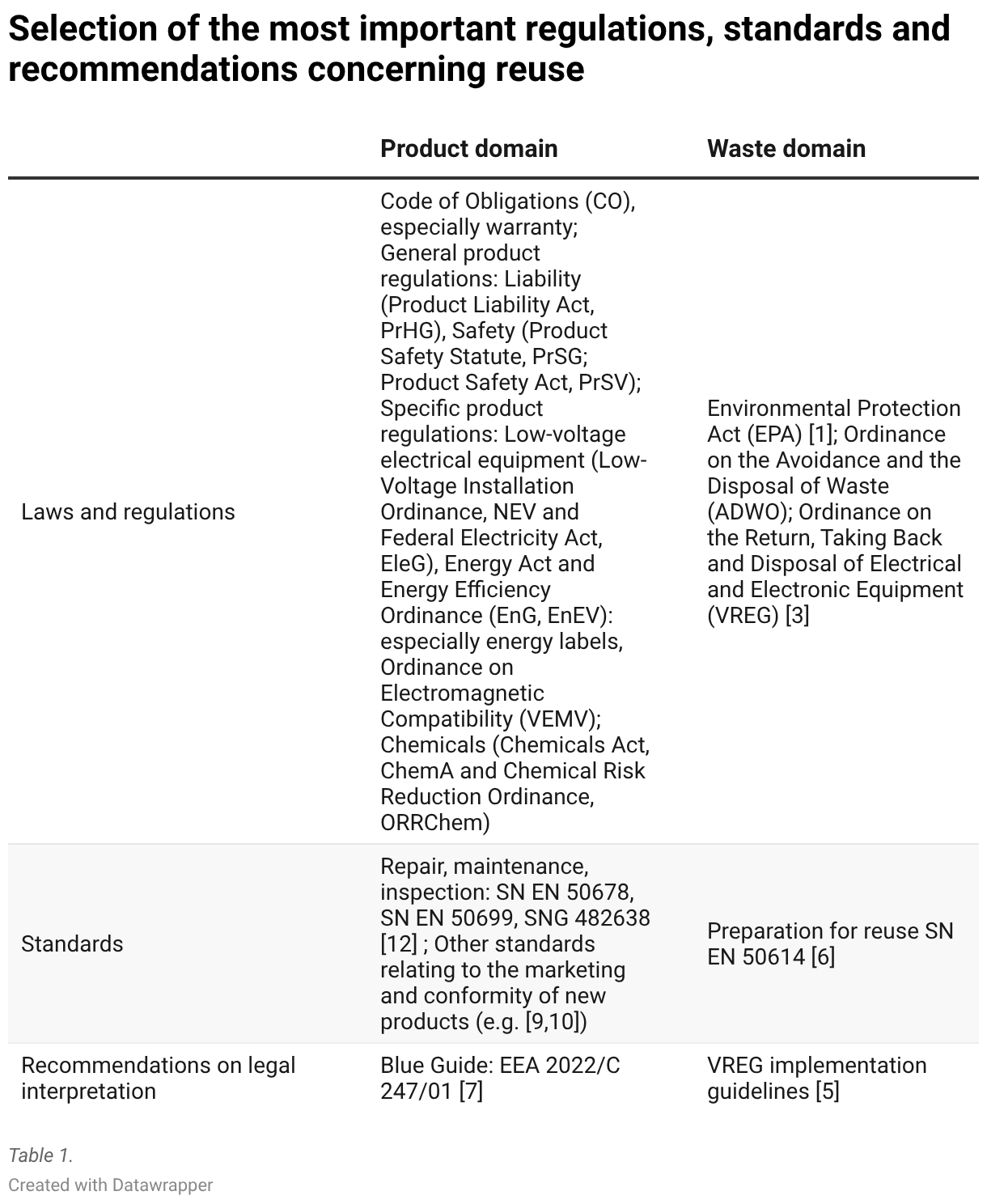
From a legal and practical perspective, it is important to distinguish whether useful life is extended in the product domain or the waste domain. If a user has a device repaired or maintained by a third party and continues to use it themselves, or if they transfer a functional device to a third party for further use, the device remains a product and these activities take place within the product domain (direct transfer). Reuse within the product domain has always been possible and online marketplaces demonstrate that there is a certain demand for it. If devices are repaired or transferred in a commercial context, product law regulations must be observed, regarding liability and product safety, for example (Table 1).
Once a consumer disposes of their device, the electrical or electronic equipment (EEE, product) becomes waste electrical or electronic equipment (WEEE) and thus waste 1 (Figure 1). This is the legal definition of waste in Art. 7 (6) of the Swiss Environmental Protection Act (EPA). Accordingly, the interpretation of disposal has a central significance in environmental law. Disposal is defined as any activity in which the intention to part with a device outweighs any other intentions.
In practice, the Federal Office for the Environment (FOEN) determines what constitutes a product or waste based on various criteria. The FOEN recommends that the enforcement authorities – i.e. the cantons –2 assume that disposal was intended in the following cases and thus regard the devices as waste:
- For non-functional devices: all cases, unless the device is returned to the original owner after repair
- For devices whose functionality is unknown: all cases.
- For functional devices: all devices that are not directly resold during commercial transactions.
Accordingly, devices that are returned to a waste collection point, a waste disposal company, or a take-back organisation (according to VREG,Regulation on the Return, Acceptance and Disposal of Electrical and Electronic Devices)3) must always be classified as waste.
Devices that are handed over to a company specialising in the testing, refurbishment and transfer of devices to third parties (commercial second-hand, retail or refurbishment businesses) are also classified as waste. Either the device donors do not get them back or it is unclear whether the device is functional. The separation of devices of unknown condition into used goods and waste is already considered waste treatment. There is also no direct sale; instead, the devices are collected and stored for testing and, if necessary, repaired. Whether the device donors are compensated for their WEEE is irrelevant in this context.
Once a device has become waste, its reuse is subject not only to the applicable product law regulations, but also to waste legislation, which entails a host of other requirements (Table 1). WEEE must undergo preparation for reuse before it can re-enter the economic cycle.
In contrast, a direct transfer of functional devices in their current condition, for example via second-hand shops, takes place in the product domain. Waste legislation (including VREG) does not apply in this case.
Preparation for reuse
Until the revision of the Environmental Protection Act (EPA) at the beginning of 2025, there was no legal provision for waste to be directly repurposed into products4. This revision established the concept of preparation for reuse in Swiss waste legislation for the first time (Art. 7 (6bis) EPA).
Preparing for reuse includes all the steps required to turn an electrical or electronic device back into a functional product that can be safely operated by a user. It comprises the entire recovery process and any necessary treatment steps, such as testing, cleaning, repair or refurbishment5.
Preparation for reuse establishes the legal basis for refurbishing waste equipment and reintroducing it into the economic cycle as used products. This follows the EU approach, which has long recognised this legal concept and issued the corresponding standard, namely SN EN 506146. WEEE that has successfully undergone preparation for reuse is generally regarded as second-hand goods7. Therefore, it does not require a new conformity assessment as it is assumed that the equipment was manufactured according to a product standard applicable at the time it was initially marketed. Consequently, legal requirements from the product domain relating to the placing on the market are not applicable.
To fulfil this assumption, all WEEE undergoing preparation for reuse must meet the following requirements:
- The CE conformity declaration is visible and the product label is undamaged6
- The model was sold in Switzerland and tested according to Swiss standards8. It can generally be assumed that this is the case if a device is equipped with a CH plug. For devices equipped with Schuko plugs (Type F plug), this is not guaranteed and must be checked more thoroughly, even if the device is equipped with a fixed adapter for Schuko plugs.
- The device was neither altered during preparation for reuse nor in the course of previous interventions or use (e.g. attempted repairs by the first user) in such a way that it no longer complies with the safety regulations of the applicable standard.
If these requirements cannot be met, or existing modifications cannot be reversed, then preparation for reuse would result in electrical and electronic equipment (EEE) that is comparable to new EEE in terms of market access. In this case, the distributor would have to prove and document compliance with all currently applicable device standards (conformity declaration). This is not feasible, as the requirements for water-heating appliances clearly demonstrate: the current requirements for marketing such a product run to more than 400 pages9, 10.
In addition to the above requirement, EEE intended for preparation for reuse must also satisfy further suitability criteria, including:
- The first user or person who surrendered the device has been informed about preparation for reuse (e.g. information at the collection point) or has given their consent (e.g. written statement). The level of consent depends on the type of device, or on the potential presence of sensitive personal data5. This represents a stricter requirement than EN 50614, which only defines requirements for storage, access and deletion of data6.
- Devices containing ‘prohibited’ hazardous substances and chemicals should be excluded from reuse – provided that adequately trained personnel are available5.
Technical requirements for preparation for reuse
The European standard for preparation for reuse SN EN 506146 also applies in Switzerland. It defines the waste-specific handling of EEE with the corresponding treatment objective and covers collection, logistics and treatment from a waste perspective. For EEE assessment, it refers to current standards in the product domain. Unlike the SN EN 50625 series of standards for recycling11, SN EN 50614 is currently not a contractual basis for partners of the two recycling systems, Swico Recycling and SENS eRecycling. It is also still relatively unknown.
With regard to testing and repair (product standards), the same standards, SN EN 50678 and SN EN 50699, apply to the testing of EEE after repair in both European countries and Switzerland. However, they are extremely complex and not very practical. Switzerland has therefore issued country-specific guidelines, namely SNG 482638, ‘Recurrent and post-repair testing of electrical equipment’12. The tests described therein are simple, quick, widely proven, safe for inspectors and explained using practical process diagrams and checklists (Figure 2).
SNG 482638 is particularly applicable to EEE with a nominal voltage of over 25 V AC and 60 V DC up to 1,000 V AC or 1,500 V DC and currents up to 63 A. Certain device categories are excluded from the scope (e.g. uninterruptible power supplies and medical devices), as they are either subject to specific requirements or the tests described are not feasible or not comprehensive enough. Nevertheless, parts of the standard, especially the described procedures and benefits of the corresponding checklists, can be helpful in meeting the necessary documentation requirements of SN EN 50614.
If EEE is collected for preparation for reuse, the following WEEE must be removed and recycled in accordance with the requirements and basic economic principles (Figure 3) before the preparation for reuse process is completed:
- WEEE that does not meet the eligibility criteria (visible and existing CE conformity declaration, placed on the market in Switzerland, no safety-related modifications, ‘prohibited’ hazardous substances)
- WEEE for which the refurbishment effort is not justified by the proceeds
- WEEE that fails the functional and safety tests
Assuming that preparation for reuse is carried out according to economic principles, the WEEE (waste) becomes a used good (product) once it has passed the functional and safety tests. It has reached ‘end-of-waste status’ (Figure 1), as it is functional, can and may be used as intended and there is a market or demand for it5.
Preparation for reuse in recycling systems
Thanks to preliminary work by the EU, it is now possible to carry out preparation for reuse in Switzerland in a technically and legally compliant manner. At the same time, the introduction of the term ‘preparation for reuse’ has created a legal basis for these activities. The framework and requirements for preparation for reuse are defined in the implementation guidelines for state-of-the-art technology. This has enabled the Swico Recycling and SENS eRecycling recycling systems to accelerate their efforts to implement preparation for reuse and gain initial experience.
For example, Swico Recycling is conducting a pilot project with established recommerce providers to test the preparation for reuse process for data-containing devices within the Swico take-back system (see here). SENS eRecycling conducted similar trials with Electro Bag in the canton of Geneva in 2022. If preparation for reuse of EEE or components is implemented within the SENS system in future, existing AI-based technologies can be adapted to identify EEE with the potential for preparation for reuse (Figure 4).
In addition to handling conventional electrical and electronic equipment, SENS eRecycling is also a take-back system for electrical and electronic equipment in the construction sector, such as photovoltaic modules. As part of an Swiss Federal Office of Energy-funded project (see here), SENS eRecycling examined the possibilities and limits of reuse and developed solutions for implementing simple and cost-effective reuse while complying with the applicable regulations.
Extending lifespan in the product domain or waste domain?
Due to the stricter regulations in the waste domain, reuse in the product domain is more cost-effective and easier to implement compared to preparation for reuse and is therefore generally preferable. This makes identifying EEE that is potentially suitable for reuse a complex process, as detailed testing is often required to detect situational faults on EEE such as loose connections, restricted functionality or error codes. Last users’ assessments of the EEE are of limited use in this regard, as they often overestimate repairability and the demand for the used device. In SENS eRecycling’s pilot project with Electro Bag, appliances were collected specifically for the purpose of reuse. 65% of users wanted their electrical and electronic equipment to be reused. However, only 25% of the material collected could actually be resold.
Accordingly, measures that aim to extend useful life in the product domain – i.e. before disposal – are preferable to measures aimed at preparation for reuse. SENS eRecycling, Swico Recycling and a number of cities, including Zurich and Vevey, have launched various campaigns to provide users with opportunities to extend the useful life of their EEE in the product domain.
At the same time, preparation for reuse does have a role to play. Due to their high complexity, preparation for reuse for intact EEE should focus on high-priced electrical and electronic equipment models in more expensive device categories for which there is a demonstrable demand for used EEE. This makes it possible to operate preparation for reuse economically. In terms of conventional EEE, this applies to items such as certain coffee machines, large household appliances, smartphones and laptops.
Alternatively, component recovery can also make a difference. These can be used either as spare parts for repairs or for the production of new EEE. The requirements outlined for preparation for reuse for devices apply equally to components: testing and clear identification are also required, while liability issues need to be clarified. When selecting components, the process must take into account not only their value and demand, but also the effort involved in removal and testing, the ability to identify the component within the supply chain and the expected quantities (Figure 4). Close involvement of the manufacturer is often advantageous for identifying such components, as their product knowledge can make a significant contribution. SNG 48263812 is not applicable to the preparation for reuse of components, but can serve as a starting point in the absence of specific information and testing methods from manufacturers.
Outlook
The framework for reuse, and especially for preparation for reuse, has been clarified in recent years. While there is still a need to gain practical experience, it is now possible to conduct preparation for reuse in a technically and legally compliant manner.
Since this creates new treatment methods and pathways in the waste management industry, existing control and supervisory activities must be continuously adapted to ensure that no unintended negative environmental impacts occur. It is important to recognise, for example, that preparation for reuse does not always make sense from an environmental standpoint. A study by Empa (Swiss Federal Laboratories for Materials Science and Technology) found that for energy-intensive devices, purchasing new EEE can have a smaller environmental impact than repairing and continuing to operate older EEE13. It must also be ensured that the export of waste continues to be thoroughly checked and that end-of-life devices may only be exported for preparation for reuse if professional preparation for reuse and functioning recycling systems are in place in the recipient country.
A look at the EU shows that the challenges facing sustainable and market-based implementation of reuse are significant, but not insurmountable. The success of any measures aimed at extending the lifespan depends on there being a demand for the resulting products. Particularly in Switzerland, with its high labour costs and high standard of living, this will remain a challenge.
Notes and Sources
- EPA (2025). Environmental Protection Act (SR 814.01) https://www.fedlex.admin.ch/eli/cc/1984/1122_1122_1122/en (accessed on 19 February 2026)
- Federal Office for the Environment (FOEN) (2025): presentation on disposal of waste electrical and electronic equipment (WEEE) – implementation guidelines. Training materials for cantons
- VREG (2023). Ordinance on the Return, Taking Back and Disposal of Electrical and Electronic Equipment (SR 814.620) www.fedlex.admin.ch/eli/cc/633/de (accessed on 19 February 2026)
- Swiss Confederation (2024). Most of the legislative changes aimed at strengthening the Swiss circular economy will come into force in 2025. https://www.news.admin.ch/de/nsb?id=103116 (accessed on 19 February 2026)
- Federal Office for the Environment (FOEN) (2024). Disposal of waste electrical and electronic equipment (WEEE) – implementation guidelines for state-of-the-art technology (VREG implementation guidelines). https://www.bafu.admin.ch/dam/de/sd-web/PslnXv61Me9P/entsorgung-von-elektrischen-und-elektronischen-altgeraeten.pdf (accessed 19 February 2026).
- SN EN 50614:2020 Requirements for preparation for reuse of waste electrical and electronic equipment. https://shop.electrosuisse.ch/de/SNEN-50614_2020_E_-52220.html (accessed on 19 February 2026)
- EEA 2022/C 247/01 (2022). The ‘Blue Guide’ on the implementation of EU product rules. https://eur-lex.europa.eu/legal-content/DE/TXT/?uri=uriserv%3AOJ.C_.2022.247.01.0001.01.DEU&toc=OJ%3AC%3A2022%3A247%3ATOC (accessed on 19 February 2026)
- Federal Inspectorate for Heavy Current Installations ESTI. Electrical products, market surveillance. https://www.esti.admin.ch/de/themen/faq/elektrische-erzeugnisse-marktueberwachung (accessed on 19 February 2026)
- SN EN IEC 60335-1:2023(E). Household and similar electrical appliances - Safety - Part 1: General requirements. https:/shop.electrosuisse.ch/en/SN-EN-60335-1_2012_A16_2023_E_424095.html (accessed on 19 February 2026)
- SN EN IEC 60335-2-15:2024. Household and similar electrical appliances - Safety - Part 2-15: Particular requirements for appliances used to heat liquids. https://shop.electrosuisse.ch/de/SN-EN-60335-2-15_2016_A1_2021_F_X-381646.html (accessed on 19 February 2026)
- SN EN 50625 Series (2014ff). Collection, logistics & treatment requirements for WEEE - Part 1: General treatment requirements. https://shop.electrosuisse.ch/de/SN-EN-50625-1_2014_E_-7448.html. (accessed on 19 February 2026)
- Requirements for preparation for reuse of waste electrical and electronic equipment https://shop.electrosuisse.ch/de/SNG-482638_2023_D_-433419.html (accessed on 19 February 2026)
- Empa (2018). Reuse and recycling of electrical and electronic equipment, ecological and economic analysis. https://www.empa.ch/documents/56122/3554929/180212_Detailstudie_Wiederverwendung_E%2BE_FINAL.pdf/a1822047-cecd-4f15-ae83-efc7ed969619 (accessed on 19 February 2026)